Our Work
Project Portfolio
Real projects, real results. Browse our work across Southeast Michigan.
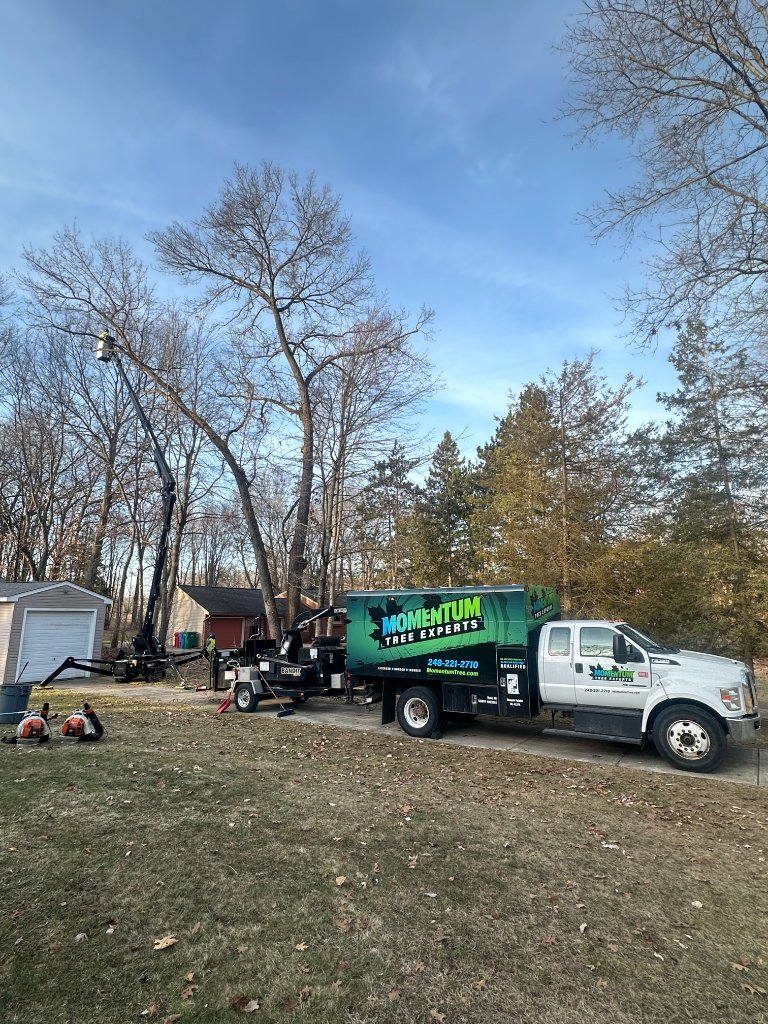
Precision Tree Pruning — Brighton, MI
Brighton, MI
Multiple small, strategic cuts outperform large single cuts every time. This Brighton property received precision pruning focused on structure, health, and longevity rather than aggressive removal. Our approach: identify crossing branches, competing leaders, and structural weakness — then remove them in controlled, appropriately-sized cuts that the tree can compartmentalize and heal. Why small cuts work better: • Smaller wounds compartmentalize faster — the tree seals the cut more effectively • Reduced shock to the tree's system • Lower risk of decay spreading into the trunk • Better structural balance and long-term health • Professional appearance — clean, arboricultural standard This isn't rough cleanup. It's biology-informed pruning that respects how trees heal. The tree will thrive for decades because we made the right cuts, the right way.
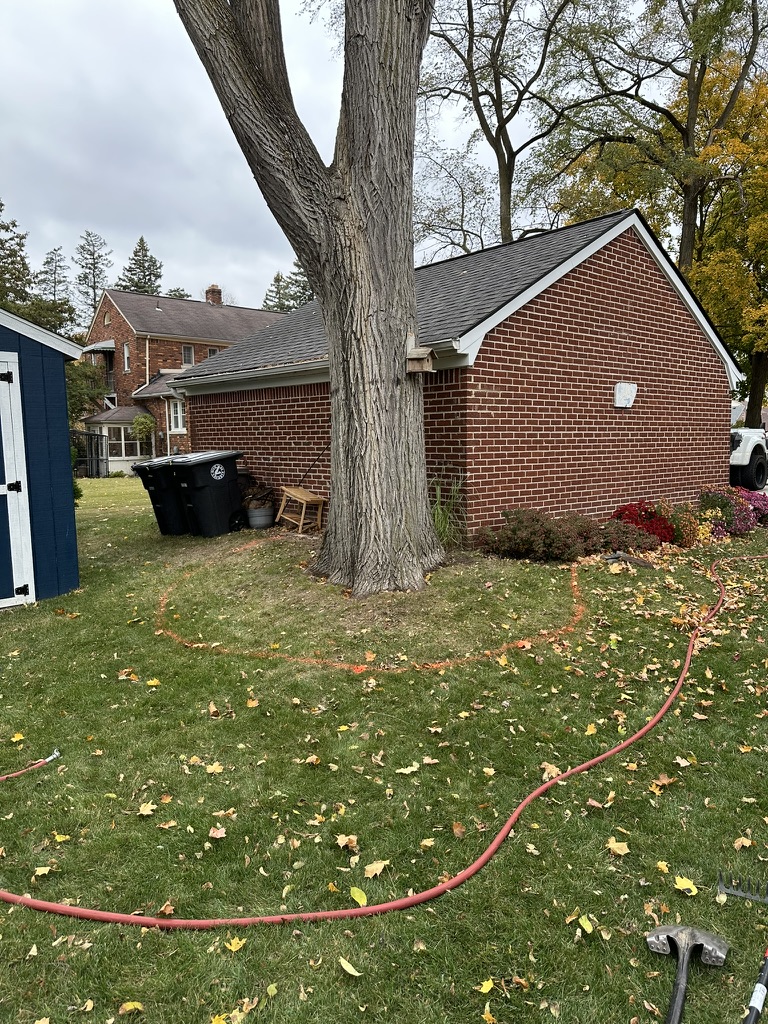
Siberian Elm Root Zone Improvement with Air Spading
Livonia, MI
A beautiful mature Siberian elm tree in Livonia, Michigan that was suffering from compacted soil and matted turf roots competing with the tree for nutrition, water, and temperature regulation. We performed air spading to improve as much of the root zone as the client was comfortable with. The photos clearly show just how much matted, compacted roots turf creates—and how removing that competition directly benefits tree health. We improved the soil composition, added supplemental nutrients, and finished with mulch for long-term benefit and ongoing support of this magnificent tree.
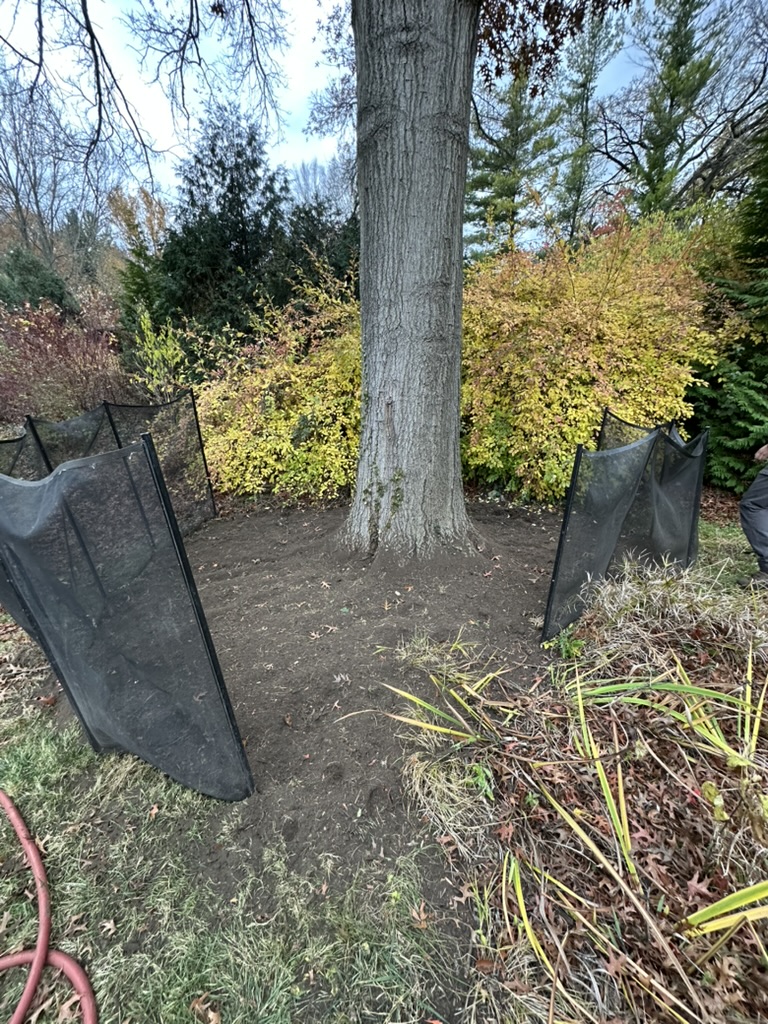
Pin Oak Nutrient Restoration with Air Spading
Ann Arbor, MI
A mature pin oak in Ann Arbor exhibiting outer canopy decline symptoms. We made multiple recommendations, but the client wasn't comfortable with chemical treatments. So we focused on what we could offer: soil and nutrient improvement around the tree. We air spaded the soil and added supplemental nutrients across the largest area the client was comfortable with, then finished with mulch. A preservation-focused approach to restore tree health naturally.
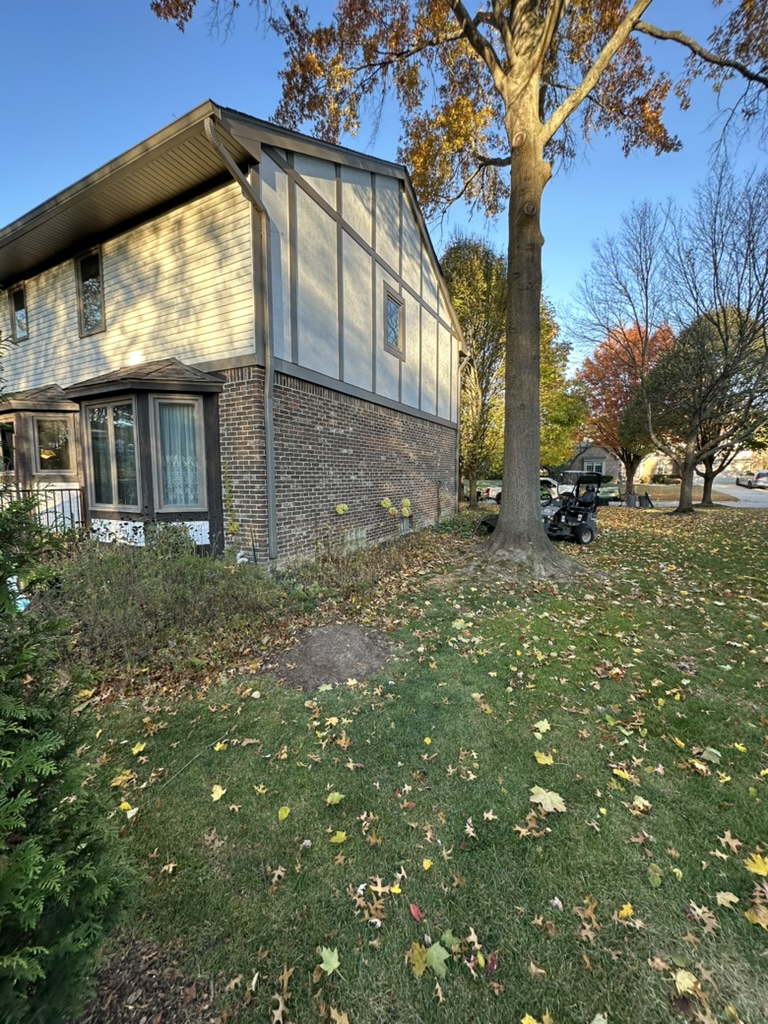
Oak Tree Soil Restoration with Air Spading
Northville, MI
A beautiful oak tree in Northville that had been overly and improperly trimmed by another contractor. Our clients noticed the tree didn't look great, so they called us in for a consultation. We addressed the over-pruning issues, but also noted that the tree was completely surrounded by vegetation and compacted dirt with poor soil conditions. Before proceeding with other treatments, we started with soil restoration using air spading—almost always the best option when possible. This preservation-focused approach improved the tree's ability to thrive and recover from the previous damage.
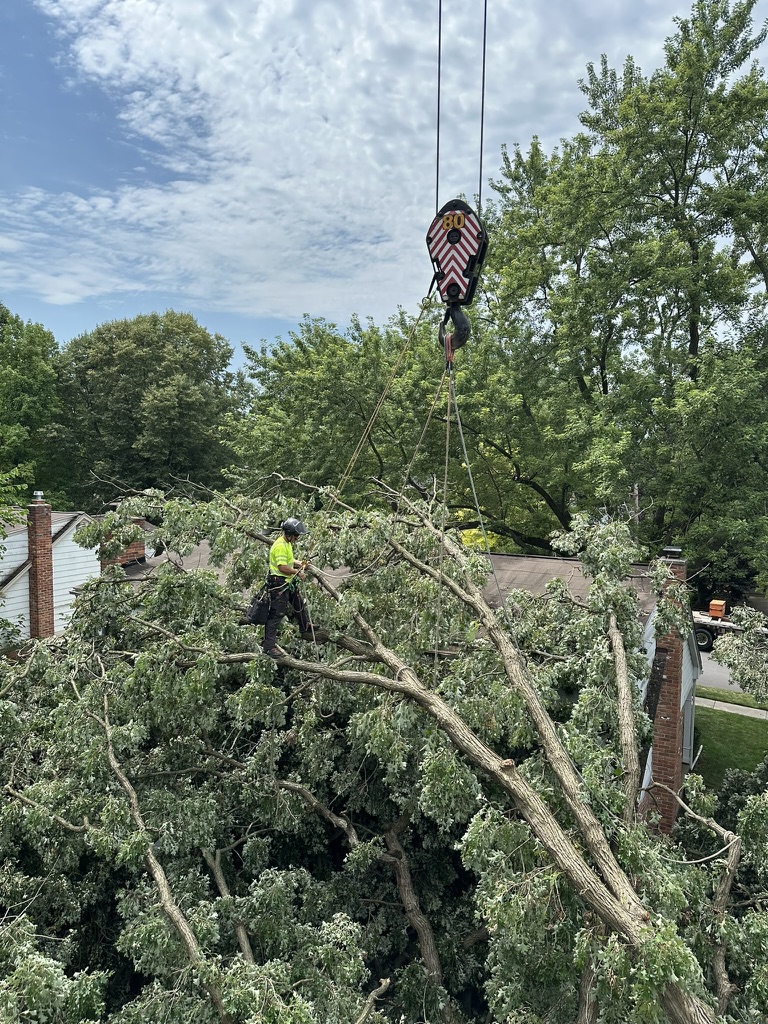
Emergency Burr Oak Tree Removal — 165 Ton Crane, 18,000 lb Trunk, Storm Damage to Two Homes | Ann Arbor, MI
Ann Arbor, MI
This was a large-scale emergency tree removal in Ann Arbor, Michigan—the kind of job that comes in at 3 AM on the phone. A massive burr oak had fallen across two homes during a storm, causing damage to both structures. The tree itself was enormous: the trunk alone weighed over 18,000 pounds. Getting it out safely required a 165-ton crane positioned at the road, which meant rigging and precision maneuvering through multiple large trees blocking the way into a backyard with almost no direct access. Burr oaks are known for their massive diameter and dense, heavy wood. This one was no exception. The challenge wasn't just the weight—it was the geometry. To get the crane lines onto the trunk and then carefully section and remove each piece without dropping anything on the homes it had already damaged, we had to work through surrounding trees, over power lines, and navigate the tight constraints of suburban Ann Arbor. This is emergency response tree work: quick assessment, heavy equipment coordination, precise rigging, and the kind of execution that shows up in photos. We documented the entire removal—the crane setup, the lifting operations, the sectioning of massive logs—because this is what professional emergency tree removal looks like when performed by a fully insured, ISA Certified Arborist's crew. If you're in Ann Arbor or Southeast Michigan and you need emergency storm damage response, we're the crew that handles the big jobs.
Massive Cottonwood Tree Removal — Lawn Protection, Stump Grinding & Full Haul-Away | Brighton, MI
Brighton, MI
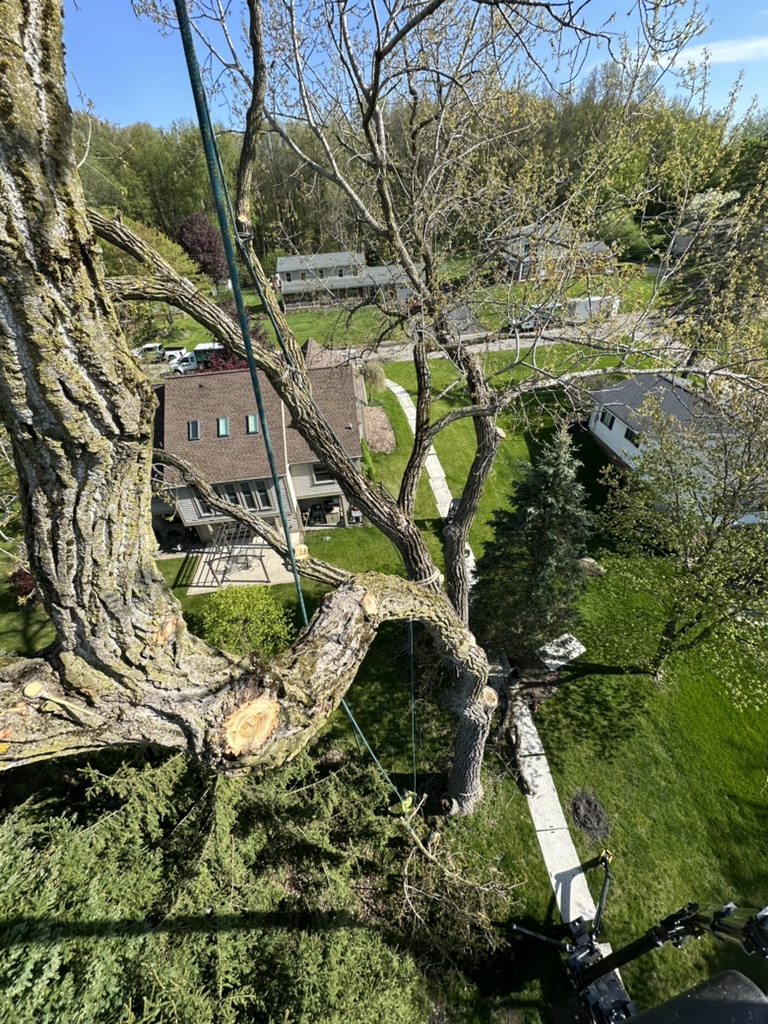
This was a large-scale cottonwood tree removal in Brighton, Michigan — one of the bigger specimens we've taken down. The tree sat at the bottom of a sloped backyard surrounded by pristine, lush lawn that the client was clear about: zero damage tolerated. That kind of expectation drives every decision on a job like this. You can see the ground protection mats laid out across the yard — a full pathway from the work zone to the road, so our equipment never touched the grass directly. The cottonwood was sectioned and lowered in controlled pieces, with rigging used throughout to direct the weight of each section away from the lawn and surrounding landscape. Once the tree was down and bucked, the stump grinding began immediately on-site. The stump sat well above grade with a massive root flare, and what looked like normal lawn around it turned out to be a former garden bed — someone had covered rocks with dirt and grass seed years ago. We ground through it all, taking the stump 8–10 inches below grade, and hauled every bit of material off the property. The final photo is the result: open, clean, level ground where a massive cottonwood stood, with the surrounding lawn untouched. No ruts, no damage, no trace we were ever there except a chip pile waiting to be backfilled. This is what professional tree removal looks like when performed by an ISA Certified Arborist's crew in Brighton, MI and across Southeast Michigan.
Large Cottonwood Stump Grinding — Oversized Root Flare, Rocky Substrate, Full Haul-Away | Brighton, MI
Brighton, MI
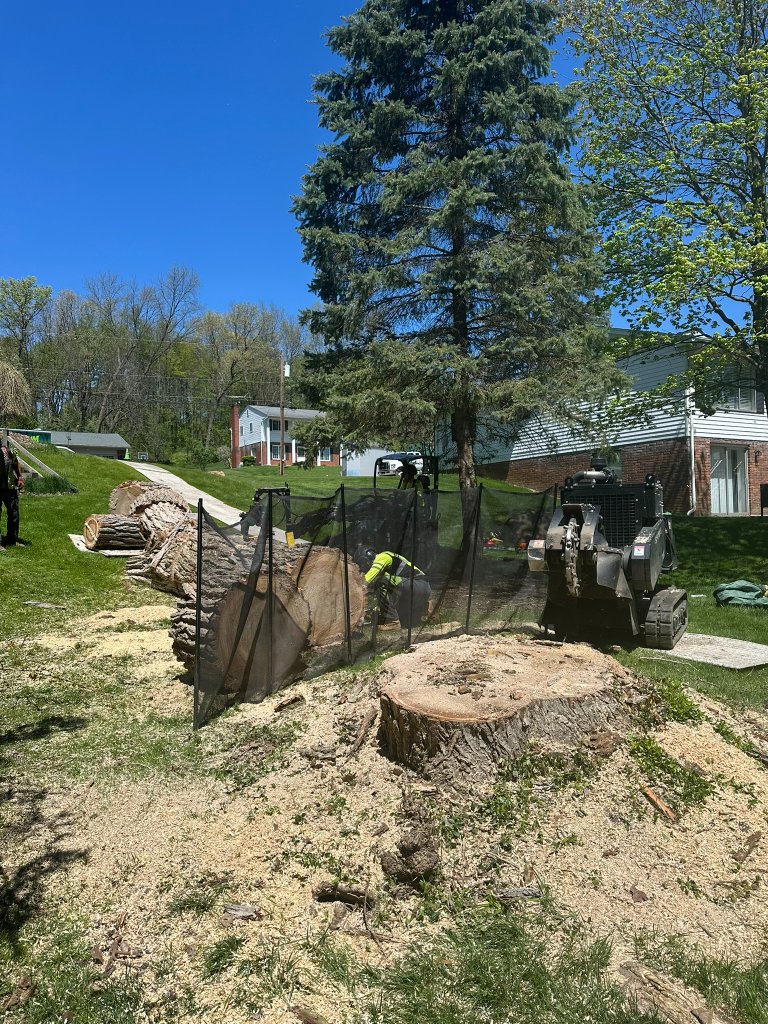
This stump grinding job in Brighton, Michigan was a big one — a massive cottonwood stump sitting well above grade with an enormous root flare spreading out in every direction. What made it especially challenging was what was hiding under the lawn: the entire area had originally been a garden bed, and at some point someone had simply dumped dirt and thrown grass seed over it. Beneath a perfectly normal-looking lawn was a layer of rocks that our grinder had to work through the entire time. Cottonwoods are one of the larger-diameter trees we encounter, and this stump was no exception. Despite the rocky substrate and the sheer volume of material, we ground the stump to 8–10 inches below grade — deep enough to allow for clean backfill, topsoil, and reseeding without any bump or void developing over time as the chips decompose. Protective screening was deployed around the machine throughout the grind, as it is on every job. All grindings and material were hauled away completely. The final photo tells the story: a clean, level patch of ground where an enormous stump used to be, with zero evidence we were ever there. This is what professional stump grinding looks like when performed by a certified arborist's crew in Brighton, MI and across Southeast Michigan — thorough, clean, and done to a standard the homeowner can build on.
Stump Grinding — Tight Access, Concrete & Rock Obstacles, Full Protective Screening | Ann Arbor, MI
Ann Arbor, MI
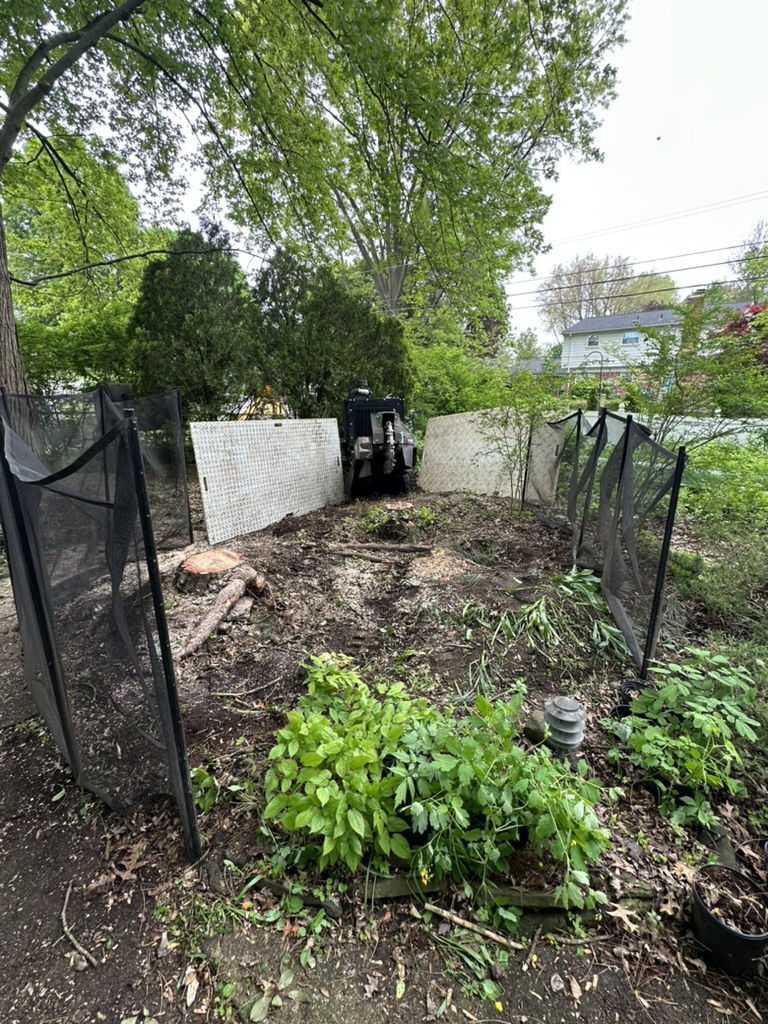
This stump grinding project in Ann Arbor, Michigan presented one of the tighter access challenges we encounter — a confined backyard space surrounded by windows, concrete, and mixed soil full of rocks and other debris that put serious demands on the grinder and the operator. Any time we're grinding in close proximity to structures and glazing, our standard protocol is full protective screening around the entire machine — no exceptions. You can see the screens deployed in the photographs, encircling the work zone completely. Flying debris from a stump grinder traveling at high RPM can cause significant property damage in an instant, and we don't cut corners on that protection regardless of how much extra time it takes to set up. Grinding through concrete-embedded root systems and rocky substrate is harder on equipment and slower work than a clean, open-soil grind — but the result speaks for itself. The final cleanup is immaculate: chips raked out, the area left clean and ready for replanting or landscaping, and not a mark on the surrounding hardscape or plantings. This is what professional stump grinding by an ISA Certified Arborist looks like in Ann Arbor, MI and across Southeast Michigan — methodical, safe, and finished to a standard the homeowner can be proud of.
Tree Brace Rod Installation — Severe Branch Bark Inclusion, Multi-Visit Preservation Plan | Farmington Hills, MI
Farmington Hills, MI
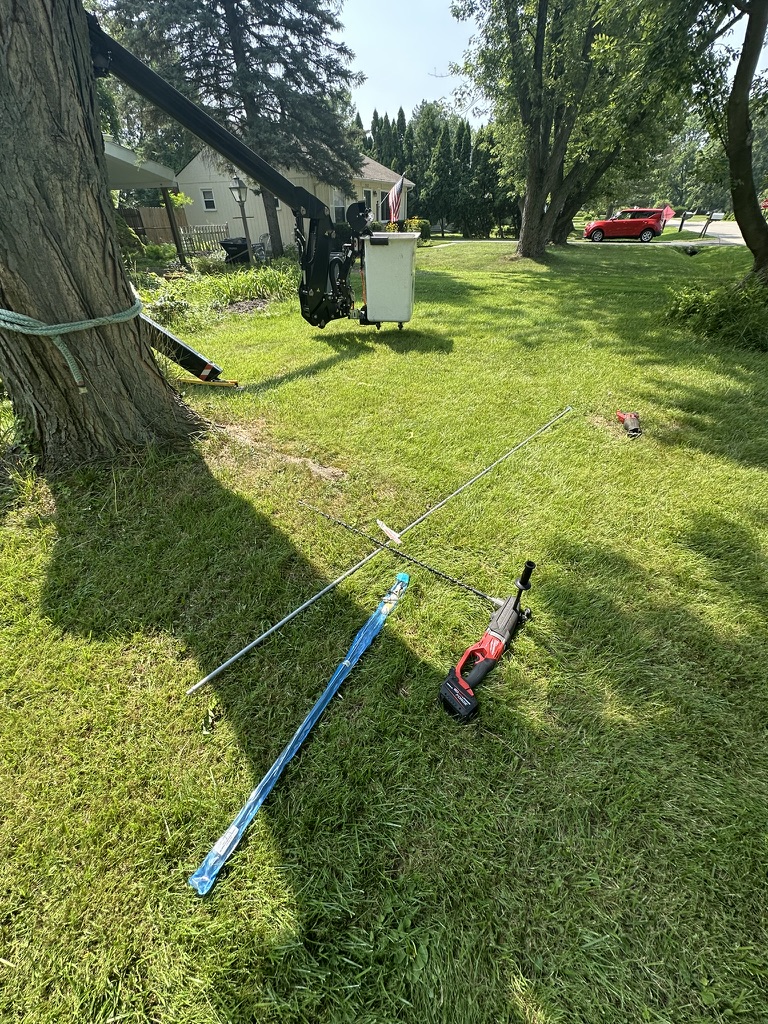
This tree bracing project in Farmington Hills, Michigan is a textbook example of advanced structural support work — and a cautionary tale about what happens when tree work is done without a certified arborist's assessment. A previous contractor had visited this property and removed an enormous limb, citing imminent failure risk. What they left behind was worse: a larger co-dominant stem with a severe branch bark inclusion — a structural defect where bark is trapped between two stems at the union, preventing the tree from forming proper connecting wood. This is one of the highest-risk structural conditions a tree can have, and it had been completely overlooked. On our first visit, we performed aggressive weight reduction on the compromised stem and installed cabling to limit the load and range of motion at the union. One full growing season later, we returned to take the next step: drilling through the trunk at the inclusion zone and installing threaded brace rods to mechanically pin the stems together. The brace rod installation is visible in the close-up photographs — a precise, through-stem procedure requiring careful placement to maximize holding strength without creating additional failure points. Brace rods work in conjunction with cabling: the cable limits lateral sway and dynamic load, while the rods resist the splitting force at the union itself. Together, they give this tree its best realistic chance at decades of continued life. This is what multi-visit, long-term tree preservation looks like when performed by an ISA Certified Arborist serving Farmington Hills, MI and Southeast Michigan.
Dynamic Tree Cabling Installation — Large Siberian Elm, Multi-Stem Support System | Livonia, MI
Livonia, MI
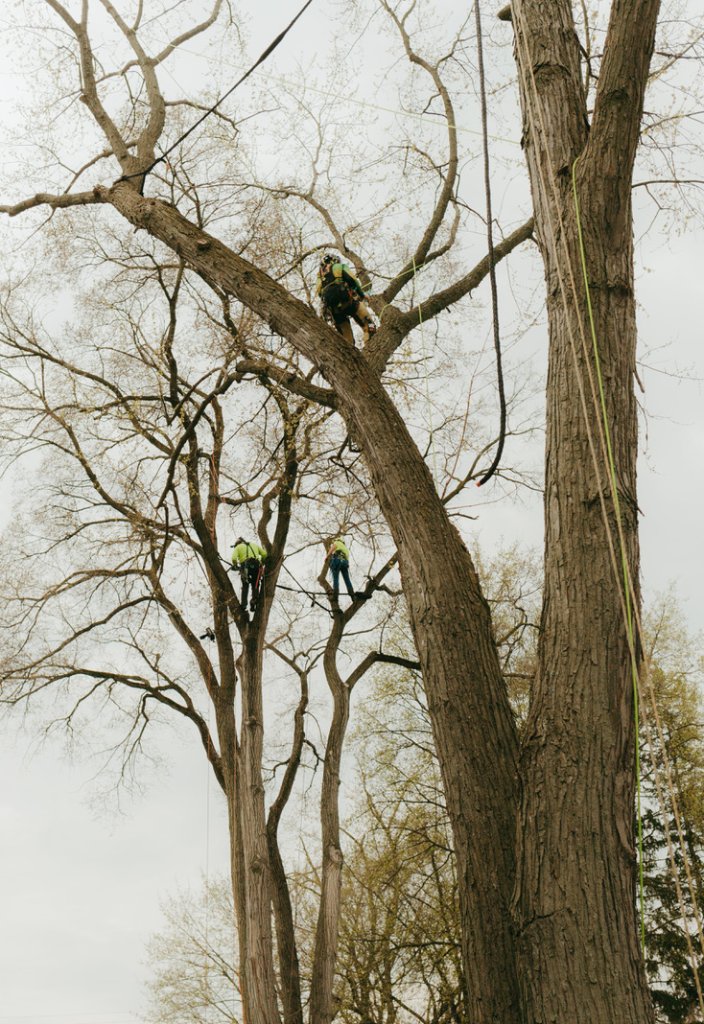
This dynamic tree cabling installation on a massive Siberian elm in Livonia, Michigan was one of the more complex cabling projects we've taken on. Siberian elms are known for their aggressive, spreading growth habit and tendency to develop heavy, wide-reaching co-dominant stems — exactly the kind of structure that benefits most from a properly engineered dynamic support system. Dynamic cabling differs from traditional steel cabling in that it allows for natural movement and flex in the canopy while still limiting the range of motion that could cause a structural failure under wind load or heavy snow. For a tree this size, the installation required multiple climbers working simultaneously at elevation to position, tension, and anchor the system correctly across the crown. As you can see in the photographs, the sheer scale of this elm demanded a full crew working in the canopy at once — a rare sight, and a testament to the complexity of the job. Every anchor point was selected to maximize load distribution across the union without creating new failure points, and the system was installed to ANSI A300 Part 3 standards. The result: a preserved, structurally supported specimen that the homeowner can enjoy for decades to come — without the risk of catastrophic stem failure. This is what professional dynamic tree cabling looks like when performed by an ISA Certified Arborist serving Livonia, MI and Southeast Michigan.
Large Oak Tree Dead Wooding — Spurless Climb, Precision Collar Cuts | Ann Arbor, MI
Ann Arbor, MI
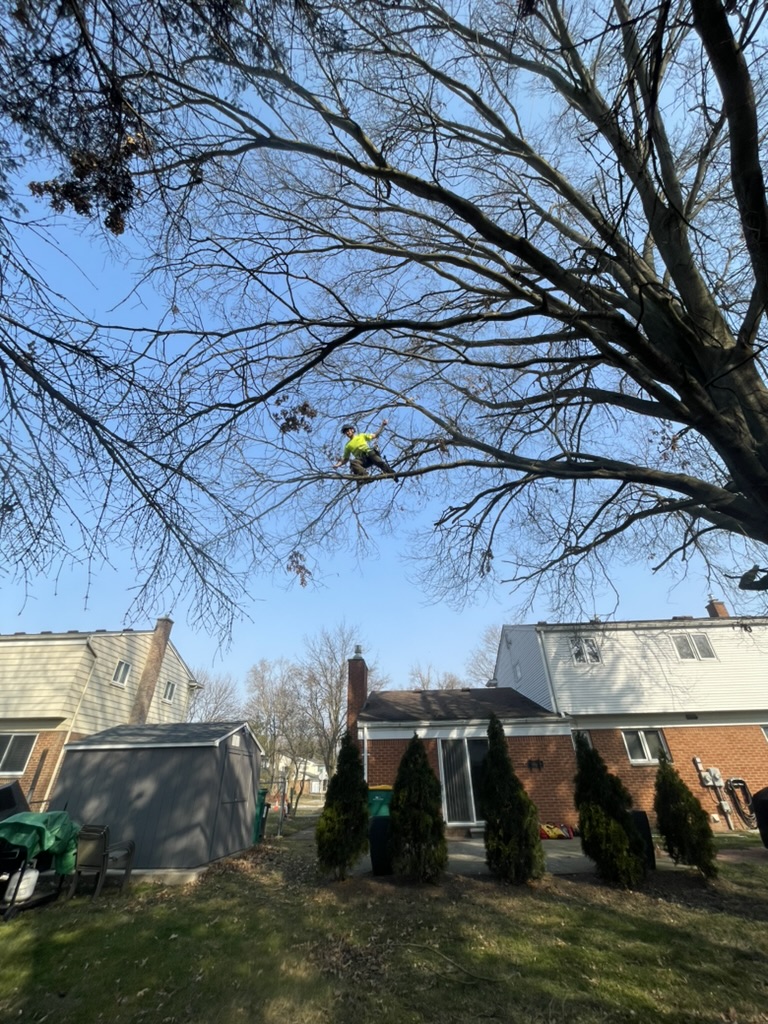
This massive, largely untouched oak in the Ann Arbor, MI area was a standout project — not just for the size of the tree, but for the level of precision required to do the job right. The canopy was loaded with deadwood ranging from small diameter tips all the way up to large, heavy scaffold limbs that had been declining for years. Dead wooding is one of the most detail-dependent services in arboriculture. On large-diameter pieces especially, the cut must be made as close to the living tissue as possible — without cutting into it. Leaving too much stub creates a decay pathway; cutting into the live wood compounds the wound. Our ISA Certified Arborist executed every cut with precision, preserving the branch collar and maximizing the tree's ability to compartmentalize each wound. This tree presented an additional challenge: it was enormous, and entirely inaccessible to an aerial lift. That meant every cut — from the canopy tips to the heavy interior limbs — had to be performed by a climber using spurless climbing techniques to protect the bark and cambium of this irreplaceable specimen. The photographs tell the story: a climber working deep inside a tree that most companies couldn't safely access, executing clean collar cuts on deadwood that had been building up for years. The tree's long-term health, reduced hazard potential, and structural integrity are all significantly improved as a result. This is what professional dead wooding by a certified arborist looks like in Southeast Michigan.
Mature Maple Tree Trimming — Neighbor Clearance & Canopy Reduction | Canton, MI
Canton, MI
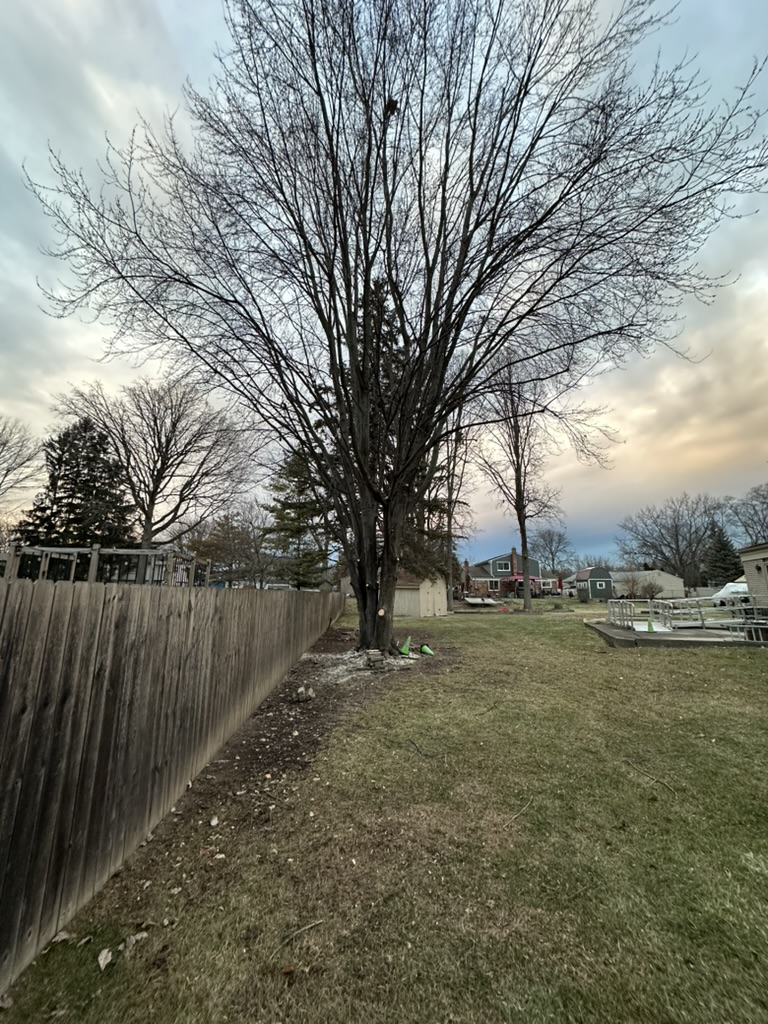
This mature maple in Canton, MI had never been significantly trimmed and had grown well beyond the property line, with large, low-hanging branches extending over a neighbor's fence and pool area. The client needed the tree brought back — both as a courtesy to their neighbor and to reduce the tree's overall footprint. Tree trimming, by definition, is driven by client objectives rather than what is ideally best for the tree's long-term health and structural integrity. Removing large-diameter branches — particularly in quantity — creates significant wound wood the tree must compartmentalize over time. Our ISA Certified Arborist understood this going in, and executed every cut with proper collar technique to minimize wound size, preserve the branch collar, and give the tree the best possible chance at sealing over cleanly. The result: a dramatically reduced canopy, cleared neighbor lines, and a final product that still looks natural and well-proportioned. This is what professional tree trimming looks like when done right — client goals met, tree health respected as much as the scope allows.
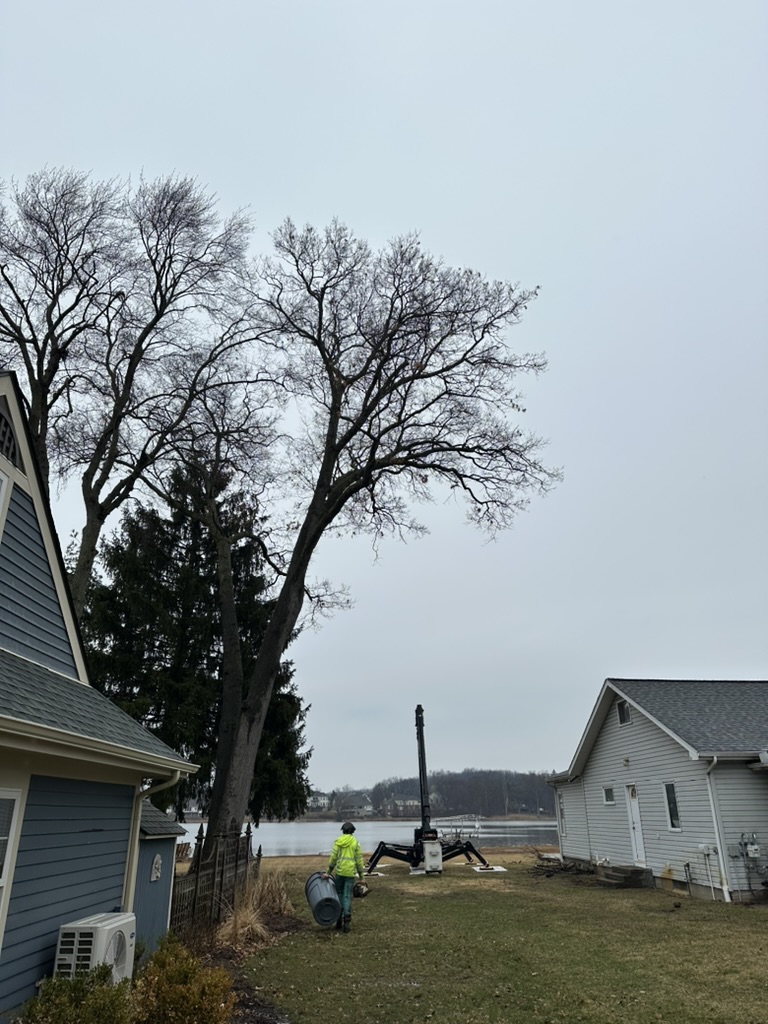
Black Oak Structural Pruning & Weight Reduction — Co-Dominant Stem, Included Bark | Wixom, MI
Wixom, MI
This large Black Oak in Wixom, MI presented a significant structural defect: a co-dominant stem with included bark at its primary branch union — one of the most common causes of catastrophic tree failure. Both cabling and pruning were recommended to mitigate risk. The client elected pruning, and our ISA Certified Arborist performed moderate-to-aggressive weight reduction on the stem facing the home. The before-and-after photos clearly illustrate the strategic distribution of cuts throughout the canopy — reducing sail area, load potential, and cross-sectional weight on the hazard stem while preserving the tree's natural form and long-term vitality. This project is a prime example of what science-based structural pruning can accomplish: dramatically reduced risk, a preserved mature tree, and zero compromise to the landscape. Proper pruning by a qualified arborist saved this tree.
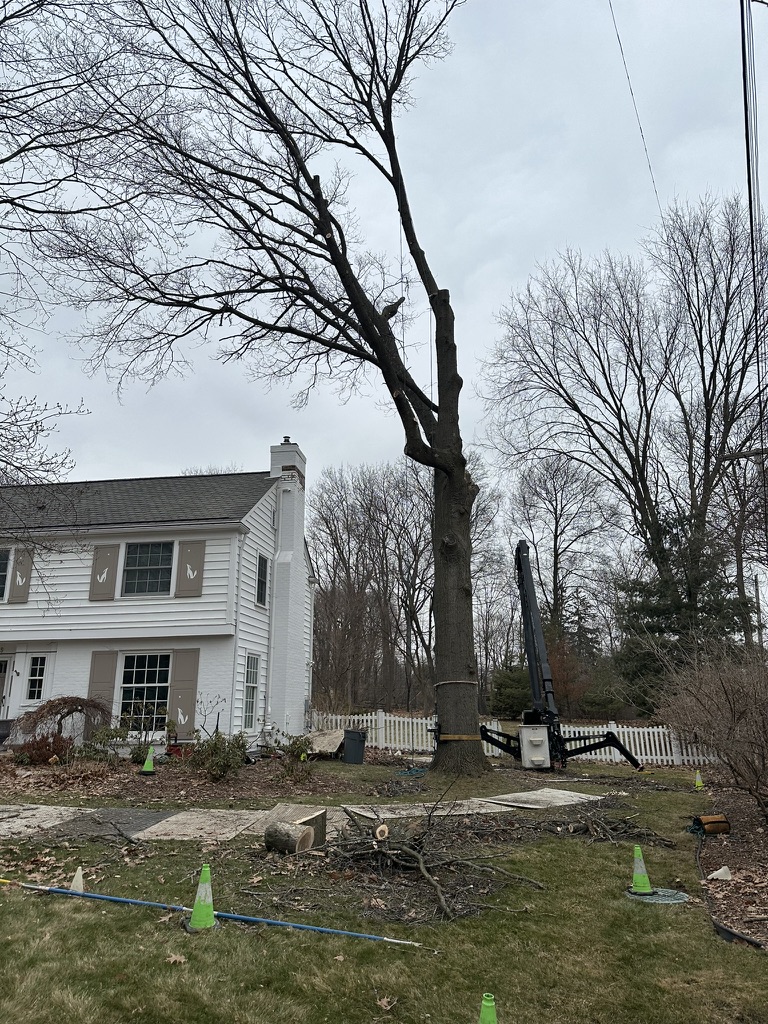
Large Declining Oak Tree Removal in Ann Arbor, MI
Ann Arbor, MI
Successful removal of a large, declining Oak tree in Ann Arbor, MI that had succumbed to hypoxylon canker disease. This high-risk tree required advanced rigging techniques due to extremely limited access — no crane could be used on site. The tree was wedged between the home and overhead primary power lines, with expensive underground drainage systems on both sides of the trunk, an AC unit, a fence, and a client garden below. Every section was carefully rigged and lowered by hand to eliminate ground disturbance and protect all surrounding structures. A technically demanding removal executed with zero damage to the property.