The Case for Preservation
Why We Fight
To Keep Trees
We don't lead with removal because we've read the research. A mature tree is not a liability to be managed — it is irreplaceable infrastructure, built over decades or centuries, that your property, your neighborhood, and the living world around you depend on. Once it's gone, it's gone for a very long time.
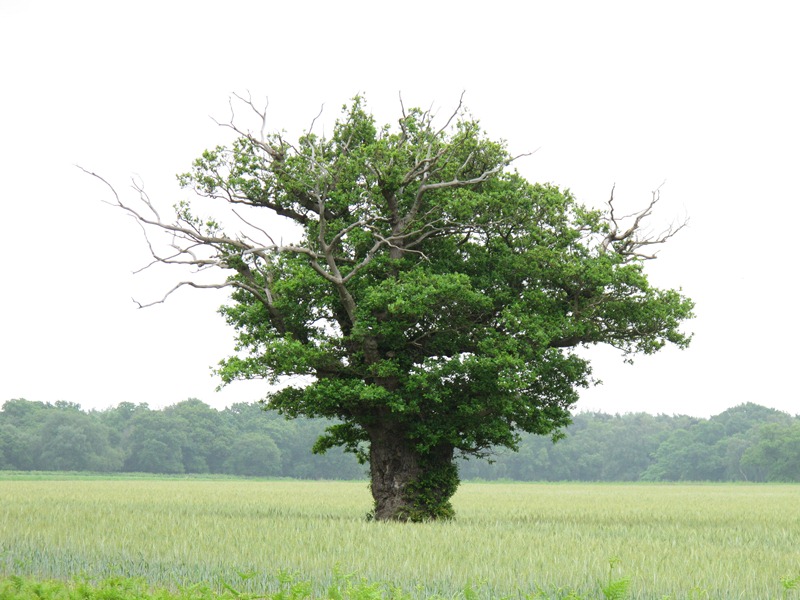
This oak is in the final stages of retrenchment — a natural, adaptive process where a mature tree sheds its outermost canopy and redirects energy inward, establishing a new, lower secondary canopy closer to its core.
Far from dying, this tree has already made its adaptation. With proper management and favorable conditions, it will continue to live for decades — possibly centuries more, providing the kind of ecological complexity, carbon mass, habitat structure, and canopy value that only a tree of this age and maturity can deliver.
No sapling planted today will provide this value in any human lifetime. This is precisely why preservation — not removal — must always be the first instinct.
What We're Losing
The US is losing urban tree cover faster than it can be replaced. These aren't abstract statistics — they represent shade that cools streets, roots that manage floods, canopy that cleans the air your family breathes.
Planting Doesn't Fix This
We hear it constantly: "We'll just plant new ones." One in three newly planted urban trees dies within five years. Those that survive spend their first decade struggling in compacted soil, urban heat, and mechanical damage before they begin to provide meaningful ecosystem services. A 100-year-old oak providing canopy for an entire block is not replaced by three saplings. It is replaced by nothing — for generations.
What a Mature Tree Actually Does
The value of a mature tree is not one thing — it's everything happening simultaneously, invisibly, every day. None of it shows up on a removal invoice.
Air Quality
US trees and forests remove 17.4 million tonnes of air pollution annually. Urban trees alone generate $5.4 billion in air pollution removal value every year — filtering ozone, nitrogen dioxide, particulate matter, and sulfur dioxide.
Nowak, USDA Forest Service, 2018
Stormwater Management
Mature tree canopies intercept rainfall before it hits the ground — old growth canopies can intercept over 59% of annual precipitation. When a street tree is removed, runoff volume increases measurably — 66 liters per square meter of canopy lost.
USDA Forest Service / USGS
Human Health
Trees don't just clean the air — exposure to tree canopy is linked to lower cortisol, reduced blood pressure, faster surgical recovery, and lower rates of depression. The research on forest bathing (shinrin-yoku) from Japan is some of the most compelling public health data in modern science.
Multiple peer-reviewed sources, NIH
Property Value
Mature trees increase property values by up to 15%. In Fulton County, Georgia, homes in tree-filled neighborhoods sold for nearly $105,000 more. A single mature tree can raise a home's value by $28,000–$76,000. Removal is a financial decision as much as an aesthetic one.
Arbor Day Foundation / USDA
Energy Use
Strategically placed mature trees reduce residential cooling costs by 15–35% and heating costs by 10–20% through shading and windbreaking. Urban forests produce $12.9 billion in reduced building energy annually across the US.
Nowak, USDA Urban Forest Statistics, 2018
Biodiversity & Habitat
A single mature oak supports over 500 species of caterpillars, insects, birds, and mammals. Young trees support almost none. The structural complexity — deep bark furrows, hollows, coarse woody debris — takes 100–200+ years to develop and cannot be fast-tracked.
Tallamy, Douglas W. — 'Nature's Best Hope'
The People Who Proved It
Our approach is grounded in the work of researchers and practitioners who spent their careers getting this right. These aren't names we drop to sound credentialed — they're the foundation of how we think.
"Trees do not heal. They seal. Understanding this changes everything about how we care for them."
Shigo's life work proved that trees respond to injury by walling off damage — not healing it. Every improper cut, every wound, every flush cut that was standard practice for decades was making trees worse. His research is why we prune the way we do today.
"The right tree in the right place, properly established and maintained, is the most cost-effective urban infrastructure investment a community can make."
Gilman's work on girdling roots, planting depth, and species selection has saved countless trees from early death. His point: most tree failures in urban settings are entirely preventable — if you start right and care continuously.
"Large old trees are keystone ecological structures. Relative to their abundance, they are disproportionate providers of resources crucial to other species."
The research is unambiguous: old trees do things young trees cannot. The habitat complexity, the carbon mass, the microclimate regulation — it accumulates over centuries. We are spending what took generations to build.
"Urban forests are among the most cost-effective public health infrastructure we have — yet we treat them as landscaping."
Nowak's i-Tree framework has given municipalities and homeowners the ability to calculate exactly what their trees are worth in air filtration, stormwater management, energy savings, and carbon storage. The numbers are almost always a shock.
When Removal Is the Right Answer
We believe in preservation — but we're not absolutists. Some trees need to come down. A tree with advanced structural failure that threatens your home, a species in terminal decline with no treatment path, a tree planted in the wrong place decades ago that has become genuinely dangerous — removal is sometimes the right call.
What we won't do is recommend removal because it's easier, faster, or more profitable than the work of assessment and restoration. That's not arboriculture. That's landscaping with a chainsaw.
The distinction matters because removal is permanent. We've seen trees written off as dead that came back with proper soil work. We've seen trees labeled "hazardous" that had no meaningful structural defect. And we've seen trees preserved past the point of reason — at real risk to people and property.
The job is to know the difference. That's what we're here to do.
Your Tree Deserves an Honest Assessment
Not a sales pitch. Not a guess. A real evaluation from someone who's read the research and spent years applying it.
Free alternatives available